 LOWIFAR BEARINGS
Understanding Needle Bearings and Their Industrial Importance
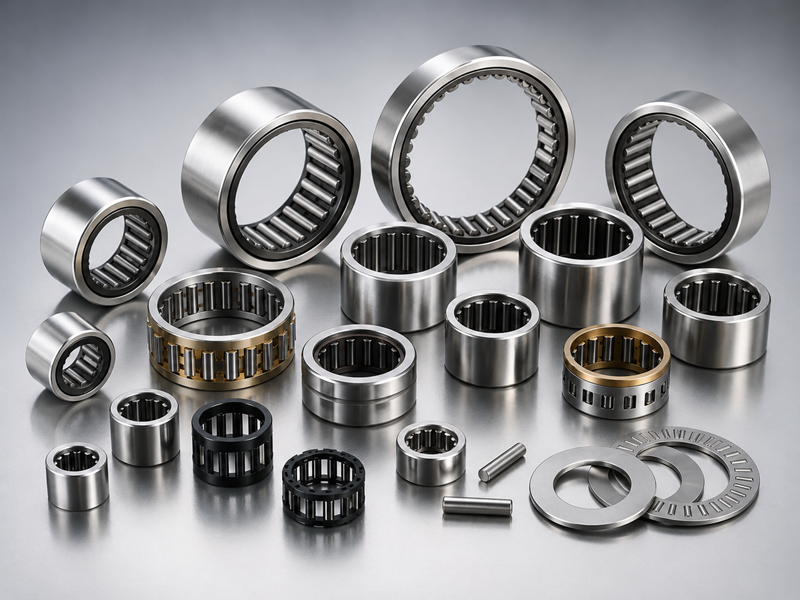
Needle bearings, also known as needle roller bearings, are a specialized type of rolling-element bearing that utilizes long, thin cylindrical rollers. Compared with conventional ball bearings, needle bearings offer a larger contact area between the rolling elements and raceway, enabling them to support higher radial loads while maintaining a compact design.
Due to their high load-carrying capacity, space-saving structure, and excellent durability, needle roller bearings are widely used in automotive systems, industrial machinery, power transmission equipment, agricultural machinery, construction equipment, robotics, and aerospace applications.
As industries continue to demand lighter, more efficient, and higher-performance mechanical systems, needle bearings remain an essential component in modern engineering.
Main Applications of Needle Bearings
Automotive Industry
Needle bearings are extensively used in automotive transmissions, gearboxes, transfer cases, steering systems, universal joints, and engine components. Their compact structure allows engineers to reduce overall system size while maintaining high load capacity.
Common applications include:
- Transmission gear assemblies
- Differential systems
- Clutch mechanisms
- Connecting rods
- Automatic transmission components
Industrial Machinery
Industrial equipment often operates under high radial loads and limited installation space. Needle bearings provide reliable performance in:
- Packaging machinery
- Textile equipment
- Printing machinery
- Machine tools
- Conveyor systems
Agricultural Equipment
Agricultural machinery operates under challenging environments involving dust, moisture, and shock loads. Needle bearings are commonly found in:
- Harvesters
- Seeders
- Balers
- Tractors
- Rotary tillers
Construction and Mining Equipment
Heavy-duty applications require bearings capable of handling substantial loads and vibration. Needle bearings are widely used in:
- Excavators
- Loaders
- Crushers
- Drilling equipment
- Hydraulic systems
Electric Motors and Power Tools
Compact needle bearings help reduce weight and improve efficiency in:
- Electric motors
- Hand-held power tools
- Pumps
- Compressors
- Gear reducers
Common Types and Models of Needle Bearings
Drawn Cup Needle Roller Bearings
Drawn cup needle roller bearings feature a thin-walled outer ring formed by precision drawing processes, making them lightweight and economical.
Popular series include:
- HK Series (Open End)
- BK Series (Closed End)
- SCE Series
- SCH Series
Typical models:
- HK1010
- HK1212
- HK1512
- BK1210
- BK1612
Needle Roller and Cage Assemblies
These assemblies consist of precision needle rollers retained by a cage, offering minimal radial cross-section and high rotational performance.
Common series:
- K Series
- KZK Series
- KBK Series
Typical models:
- K101413
- K152010
- K202520
Machined Ring Needle Roller Bearings
Designed for heavier loads and greater rigidity, machined ring bearings provide superior performance under demanding conditions.
Common series:
- NA Series
- RNA Series
- NKI Series
- NK Series
Typical models:
- NA4900
- NA4905
- RNA4908
- NK20/20
- NKI25/20
Needle Roller Thrust Bearings
Needle thrust bearings are specifically designed to accommodate axial loads while maintaining compact dimensions.
Popular series:
- AXK Series
- AS Series
- GS Series
Typical models:
- AXK1024
- AXK1528
- AXK2542
Combined Needle Roller Bearings
These bearings combine radial and thrust bearing functions into a single unit, reducing assembly complexity.
Common series:
- NKIA Series
- NKIB Series
- ZARN Series
Applications include machine tools, robotics, and precision transmission systems.
Common Materials Used in Needle Bearings
High Carbon Chromium Bearing Steel (GCr15 / SAE 52100)
GCr15 bearing steel is the most widely used material for needle bearings due to its excellent balance of hardness, wear resistance, fatigue strength, and cost-effectiveness.
Key benefits:
- High hardness after heat treatment
- Excellent rolling fatigue life
- Good dimensional stability
- Suitable for most industrial applications
Stainless Steel
For corrosive or humid environments, stainless steel needle bearings provide enhanced corrosion resistance.
Common grades:
- AISI 440C
- SUS440C
- AISI 316 (special applications)
Applications:
- Food processing equipment
- Pharmaceutical machinery
- Marine equipment
- Medical devices
Tool Steel
Tool steels are sometimes selected for specialized high-load or high-temperature applications where additional hardness and wear resistance are required.
Ceramic Hybrid Components
Certain high-speed applications utilize ceramic rolling elements combined with steel raceways.
Advantages include:
- Reduced friction
- Lower operating temperatures
- Electrical insulation properties
- Extended service life
Typical ceramic materials:
- Silicon Nitride (Si3N4)
- Zirconia (ZrO2)
Cage Materials
The performance of a needle bearing is also influenced by cage material selection.
Common cage materials include:
- Steel cages
- Brass cages
- Nylon (PA66) cages
- PEEK cages
- PTFE cages
Engineering polymers such as PEEK and PTFE are increasingly used in high-speed, chemical-resistant, and maintenance-free applications.
How to Select the Right Needle Bearing
When selecting a needle bearing, engineers should evaluate several critical factors:
- Radial and axial load requirements
- Operating speed
- Available installation space
- Environmental conditions
- Lubrication method
- Corrosion resistance requirements
- Service life expectations
Choosing the correct bearing type, material, and internal clearance can significantly improve equipment reliability and reduce maintenance costs.
Future Trends in Needle Bearing Technology
With the development of automation, electric vehicles, and intelligent manufacturing, demand for high-performance needle bearings continues to grow. Manufacturers are focusing on:
- Advanced heat treatment technologies
- Low-friction surface engineering
- Ceramic hybrid solutions
- Corrosion-resistant materials
- Lightweight bearing designs
These innovations help improve efficiency, extend service life, and support increasingly demanding industrial applications.
Conclusion
Needle bearings play a crucial role in modern mechanical systems by providing high load capacity within a compact design. Whether used in automotive transmissions, industrial machinery, agricultural equipment, or precision automation systems, selecting the appropriate needle bearing type and material is essential for achieving optimal performance and reliability.
Understanding the characteristics of common models such as HK, BK, NK, NKI, NA, RNA, and AXK series, together with material options including GCr15 bearing steel, stainless steel, and ceramic components, allows engineers and purchasing professionals to make informed decisions for their applications.